
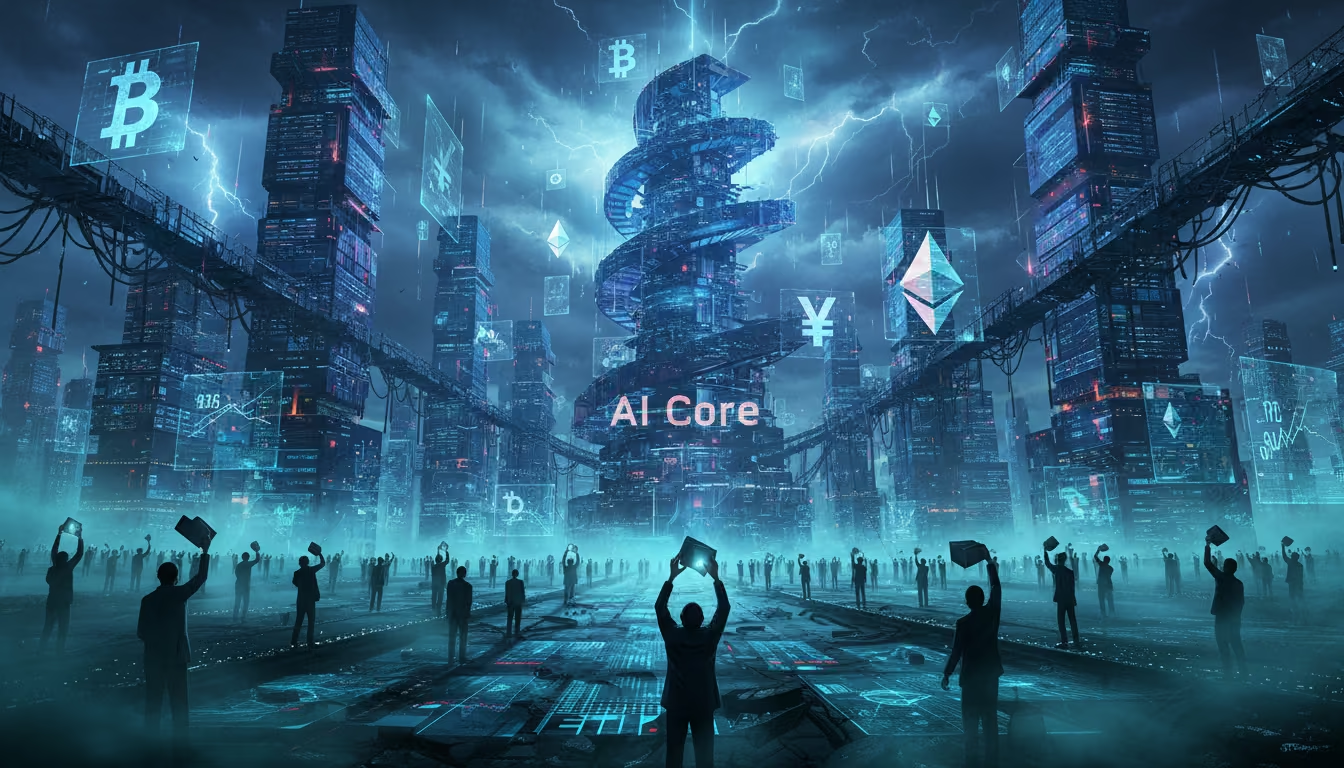
Explore why central bankers and financial stability experts are increasingly concerned about the AI boom, market concentration, inflation risks, stablecoins, and systemic financial threats.
The Scope of What We’re Facing
Alright, let’s be real, what’s happening in AI space? We are seeing something remarkable. It’s a technological shift some are comparing to electrification and the early days of the internet, but with implications for global finance that we are just beginning to understand.”
The figures coming out of Silicon Valley and elsewhere are truly staggering. The big tech companies are going to spend hundreds of billions of dollars on AI infrastructure over the coming years. This is not hype, this is real capital with real consequences. It’s a speed of investment that we’ve never seen before, and while it shows a real belief in the promise of AI’s transformative potential, it also raises some uncomfortable questions around what happens when that much money moves that fast into a single sector.
It’s not the innovation that scares me, quite the contrary. The problem is the dynamics of concentration. The companies with the deepest pockets are building moats that the little guys just can’t cross. What we’re seeing is the emergence of what we might more politely call “winner-take-most” dynamics, where a handful of companies amass the talent, computing power and data assets needed to compete at the cutting edge. This is not just a competition issue, although regulators are right to watch closely, it is a financial stability issue. If system risk is concentrated in a few large players, then the failure of any one of them is a concern for everyone.
If you’ve been around long enough, it all sounds eerily familiar. During the 1920s electrification boom, investors threw money at anything with a plug, pushing valuations to meaningless levels relative to underlying business fundamentals. The technology was revolutionary, and electricity did change industry and everyday life, but the financial mania that went along with it did produce real economic damage when the correction came.
Then came the internet bubble of the late 1990s. I’ve seen companies with no revenue and dubious business models raise billions of dollars in funding on the “.com” potential alone. The internet did deliver on its promise in the end, but the crash in the meantime wiped out trillions of dollars of market value and set back legitimate innovation for years.
The question we should be asking is not if AI is transformative, it is. The question is if we are falling into the same valuation disconnect pattern we saw in those earlier episodes. I get nervous when I see AI companies trading at multiples that imply near perfect execution for 10 years. I get even more nervous when I hear investors say, “This time it’s different.”
The Inflation Puzzle That No One Is Talking About
And here is where it all begins to get really complicated. In the long run, AI could be hugely deflationary productivity, automation, efficiency gains. But what about now? That’s where the perils are.
What I would call “chipflation” is already happening the semiconductor supply chain simply cannot meet AI-driven demand. This is no blip. It takes billions of dollars and years to build new fabrication capacity. Meanwhile, chip prices are rising and those costs ripple through the whole economy. That pushes up the cost of making every smartphone, every car, every piece of industrial equipment that relies on sophisticated chips.
Central banks face cross-pressures. If AI investing is overheating the economy, we may have to raise rates to cool it down. Higher rates also make it more costly for AI firms to fund their massive capital requirements, potentially sparking a correction that could reverberate throughout the financial system. This is exactly the sort of “disruptive macro-financial feedback loop” that the Bank for International Settlements (BIS) has warned about and they have good reason to be worried.
And the timing couldn’t be worse. Many central banks are still dealing with the aftermath of post-pandemic inflation, and adding AI-induced price pressures to the mix creates a policy headache of the first order. Do you tighten to cool inflation and risk popping the AI bubble? Or do you let inflation run a little hot, to avoid unleashing a tech-driven financial crisis? There are no good choices here.
The Stablecoin Wild Card
And just when you thought the picture was complicated enough, let’s talk about stablecoins. These aren’t your father’s cryptocurrencies, they’re trying to keep their value stable by backing themselves with stores of traditional currency or other assets. And they’re multiplying like rabbits.
How does this relate to the AI chat? Two things. First, many stablecoin issuers are turning to AI for trading algorithms, risk management and operational efficiency. Second, the use of stablecoins for real economic activity is growing and not just for speculation. If stablecoins become a significant part of the financial plumbing, central banks will have less control over the transmission of monetary policy. If there is a lot of economic activity outside of traditional banking channels, changes in interest rates may not be as effective.
The regulatory response has been anything but coordinated, and the risks are piling up. A run on a stablecoin could result in fire sales of the assets backing it, leading to wider market disruption. AI-driven trading algorithms might perform trades that destabilise stablecoin markets. These are not hypothetical things, these are emerging risks that require serious attention.
Related: AI Making DeFi Unsafe? Experts Warn of Rising Crypto Security Threats
Where Do We Go From Here?
So where do we go from here?
Policy makers will have to weigh a real excitement about the potential of AI with the very real risks of financial instability. We shouldn’t kill innovation. That would be throwing the baby out with the bath water. But we shouldn’t draw the wrong lessons from previous bubbles because the technology is different this time.
“I want to see a more sophisticated approach to regulation. Not blanket bans, but considered guardrails that reduce concentration risk, promote transparency around AI valuation, and create early warning systems for when speculative excess begins to threaten market stability. There is a sense in the central banking community that they are beginning to come together on these issues, but we are behind a technology that is moving faster than most regulatory processes.
Related: AI Agent Liability Explained: Who Is Responsible When AI Goes Wrong?
Bottom line: AI will reshape our economy in significant ways, and that is ultimately a good thing. But the magnitude of change brings real financial stability risks that we ignore at our peril. The question is not should we adopt AI, that ship has already left the dock. The question is whether we can handle the transition without causing a financial crisis that destroys the very benefits we are trying to achieve.
Related: Kraken Layoffs Show How AI Is Reshaping the Crypto Industry