
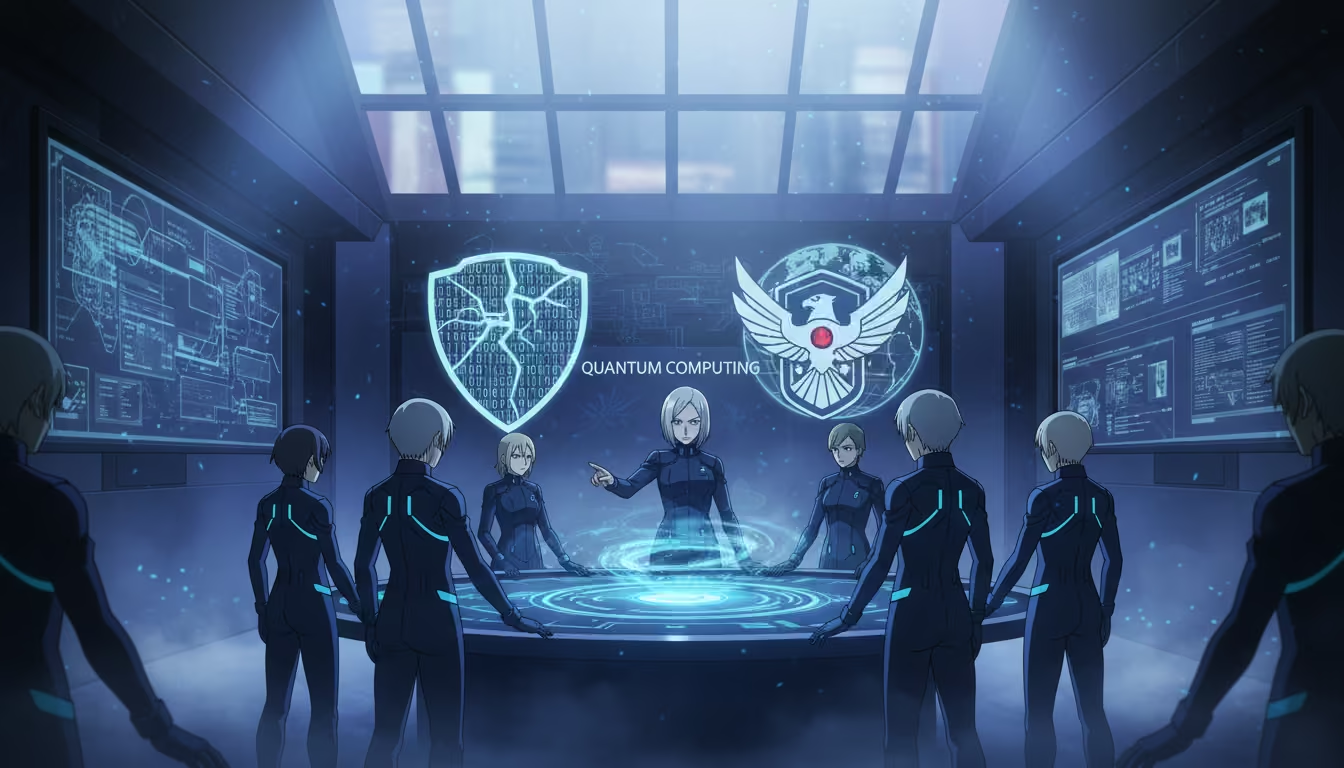
An in-depth analysis of U.S. executive orders on quantum computing, post-quantum cryptography, national security risks, and the global race for quantum leadership.
The Latest US Executive Orders: A Comprehensive Review of Quantum Computing and Cryptography
When President Trump signed those executive orders back in 2020, the quantum community collectively exhaled. Not because we suddenly had all the answers far from it but because the administration finally recognised what those of us working in quantum R&D have been saying for years: this technology isn’t some distant theoretical exercise. And it’s coming, faster than most policy makers realise, and we are poorly prepared for its implications.
Let me be blunt about what we are really talking about here. Conventional computers work with information in bits, ones and zeros. Quantum systems use qubits that exploit superposition and entanglement to perform calculations that would take classical machines millennia. This field has expanded from lab experiments involving a few qubits to systems nearing hundreds. It’s an exponential curve and the turning point is closer than most people think.
The orders themselves were ambitious, but pragmatic. The QC-ADD initiative was launched and a full refresh of our national quantum strategy was directed within 180 days. That timeline was aggressive, but it hinted at something important: the administration understood that bureaucratic inertia could not be allowed to slow quantum development.
But what was most impressive to me was not the funding pledges, though those were appreciated, it was the acknowledgement that quantum progress requires real partnerships between government labs, private industry and academic research centers.
The Security Implications Nobody Is Talking About
Here’s where it gets uncomfortable. Most of the world outside the field has no idea how profound a threat quantum computing presents to our existing cryptography infrastructure. When scalable quantum computers arrive and I’m increasingly convinced 2030-2035 is a realistic window they’ll break RSA and ECC encryption like they’re kids’ puzzles. All the sensitive data ever encrypted with these methods is in danger. Not in the end. Right now.
We have known about this vulnerability for years. The National Institute of Standards and Technology (NIST) began its post-quantum cryptography standardisation process in 2016. But uptake has been slow in industry. Most organisations, including government agencies, have approached this as a future problem. No it isn’t. Data encrypted today may be intercepted and stored for decryption tomorrow. This is not theoretical, this is operational security 101.
Rlated: Ethereum’s Quantum Threat Solution: How SPHINCS+ Could Protect Crypto for Just Seven Cents
The executive orders sought to speed up our transition to quantum-resistant algorithms. They directed agencies to inventory their cryptographic systems and create migration roadmaps. But, I’ll be honest, the follow-through has been spotty. Some agencies have embraced the mandate; others have gone through the motions hoping the problem will go away. It wont.
Related: Trezor Unveils Safe 7: The First Hardware Wallet with a Transparent Secure Element and Quantum-Ready Design
Competition’s International Dimension
China has made huge investments in quantum. And they’re not only matching US spending, they’re often surpassing it, especially in quantum communication networks. China has already deployed quantum-encrypted links between major cities and launched Micius, the world’s first quantum satellite. Meanwhile, most of our efforts in quantum internet are experimental.
This is a race we can’t afford to lose. Quantum technology will underpin everything from next generation drug discovery to materials science to artificial intelligence. The country that wins in quantum computing will have a huge strategic advantage in almost every aspect of technology.
But I’d be careful about seeing this as a game of winners and losers. The quantum ecosystem is in a very real sense global in ways that previous technological revolutions were not. European researchers are making a great contribution. Some really interesting work is coming out of Canadian companies. Some of the most promising qubit technologies have been pioneered by Japanese materials scientists. We need to balance national competitiveness with international cooperation especially on standards development.
A special mention goes to the emphasis on workforce development. “Quantum technology requires an interdisciplinary skillset that our education system hasn’t traditionally trained people to have. Physicists, computer scientists, materials engineers and mathematicians need to work together, speaking a common language. The executive orders directed more education programs and research grants to build that pipeline.
The focus on public-private partnerships was equally clever. One of the most exciting quantum work I have seen is in start-up companies spun out of university research, working with established tech companies. Google’s quantum supremacy demonstration, IBM’s commercial quantum systems, Rigetti’s superconducting qubits these advances all emerged from an ecosystem in which government funding and corporate R&D fed off each other.
Continuing Concerns
I do have some reservations about the execution. The 180-day deadline for updating our strategy came and went with less transformational change than many of us had hoped for. Coordination between agencies remains difficult. Quantum does not always fit neatly into existing bureaucratic structures, and different departments have different priorities.
Funding is fragmented across multiple agencies, though increased. We need more coherent investment fewer boutique projects and more strategic, sustained support for breakthrough research. China has followed this kind of strategic continuity.
The Future
These initiatives are there for the next administration to pick up on and I hope they build on them and don’t start from scratch.” Quantum technology is not beholden to election cycles. The choices we make (or fail to make) today will decide whether the United States will lead on what is becoming the preeminent technological frontier of the next several decades.
This is a moment of truth. The executive orders showed that Washington understands the stakes. What we need now is sustained commitment, real investment and political will to see this through. Because if we blink, if we get diverted by short-term priorities from long-term strategic necessities, we will not just lose a race on technology. We will lose a fundamental advantage in security, in trade and in the process of scientific discovery.
And no, that’s no exaggeration. That is the world we live in.