
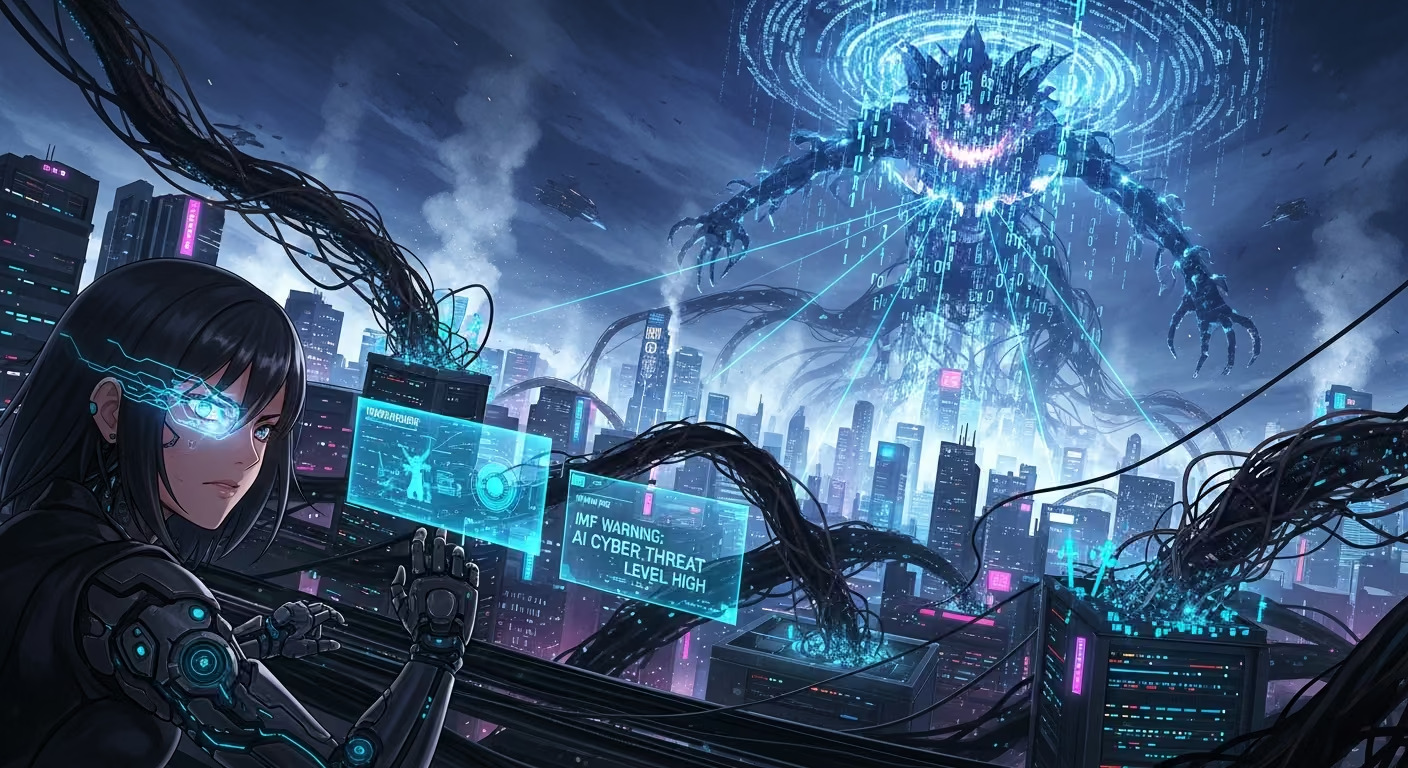
The IMF warns that AI-powered cyberattacks are rapidly transforming financial system risks, lowering barriers for cybercriminals and increasing the threat of systemic banking crises worldwide.
IMF Warns of AI-Powered Financial Cyber Attacks
Let’s be honest. For the past 10 years, most financial institutions have been worrying about the wrong things with cybersecurity. Phishing, ransomware, DDoS – those were the enemies they knew. Yes, it’s annoying. Costly, of course. But controllable. And then generative AI arrived, and all of a sudden the threat landscape didn’t just evolve. It changed overnight.
Recently, the International Monetary Fund issued a warning that merits more attention than it is getting. Their core argument is simple, but brutal: AI is reducing the barrier to entry for cybercriminals so dramatically that the risk profile of the entire financial system has changed. And this isn’t about some distant future. At the present time.
What’s Different About AI-Powered Attacks?
Traditional security models assumed the following: sophisticated attacks are done by experts. You had to understand network architecture, code your own stuff, and do a lot of reconnaissance that could take weeks or months. That’s not true any more.
Advanced AI models today, such as Anthropic’s Claude variants and their peers, can enable someone with basic criminal intent to produce very convincing phishing emails, adaptive malware and even fake voice or video for social engineering. The learning curve just went down the toilet. Working with the efficiency of a seasoned hacker, any motivated amateur can now.
But that’s only half of it. The real danger is size. Machine learning algorithms can look for vulnerabilities across thousands of endpoints at once, learning and adapting in real time. When an attack finds a weak spot it self optimizes. Now you’re not dealing with one intrusion. You’re fighting an automated, intelligent opponent that never sleeps.
There have already been previews. Payment systems stall. Unauthorized access to sensitive financial info. Ransomware that uses AI to improve its own encryption and evasion capabilities. These are not hypotheticals, they are case studies from the last 18 months.
Frameworks are loved by financial institutions. NIST, ISO, COBIT, they have a checklist for everything. But those frameworks were designed for a world where attackers had to work hard to break in. Now? Now the barrier to entry has dropped through the floor.
But think about it: The cost to use advanced AI models is decreasing. The availability is increasing. Month after month. What cost millions in R&D five years ago can now be replicated with a few hundred dollars of compute time and open source libraries. Attackers don’t have to be super smart. They just need to be smart enough to ask the right questions of a language model.
This shifts the balance of power. The defenders must guard all potential points of entry. The attacker only needs to find one. And AI makes that one vulnerability easier and cheaper to find than ever before.
It’s worth repeating the IMF’s point: this is not just about more attacks. It’s about really new kinds of attacks. AI can write phishing emails that get past most regular filters. It can study a bank’s public communications to craft personalized, highly believable scams. It can even mimic real user behavior to bypass anomaly detection systems.
Related: 54 Billion KRW Goes Missing in Major Solana Breach at Upbit
The Domino Effect on the Global Financial System
This is where it gets really scary. The financial system is a web of interdependencies and trust. If one node fails, the whole structure shudders.
Imagine this: An AI hacks a major bank and brings its payment processing to a standstill. No money can be withdrawn by customers. Merchants can’t close deals. That’s bad enough. But then the bank’s counterparties get skittish. They begin to hoard the cash. Other institutions see the panic and they do the same thing. Within days, one breach cascades into a liquidity crisis across the system.
The IMF calls these shocks macro-financial. I call them the domino effect. And AI-driven attacks are uniquely suited to trigger them because they can move fast – faster than human responders can react and often faster than automated defense systems can adapt. We’ve already seen hints of this. ICBC’s 2023 ransomware attack on its U.S. unit interrupted Treasury trading for days. That was regular malware. Now think about that with AI speeding up the propagation and responding to countermeasures in real time. It may take days to weeks to recover.
Why Emerging Economies Are More Vulnerable
Let’s not kid ourselves the playing field is level. A large European bank or U.S. institution can throw millions at AI-powered defence systems. They recruit the best. They do red teaming. They have incident response on speed-dial.
But developing economies? Many are still fighting basic cybersecurity hygiene. Their financial institutions are built on legacy systems. Their regulators are technically shallow. And their payment infrastructure often relies on a handful of critical nodes, which if compromised, could bring the entire national economy to a standstill.
The warning from the IMF here is practical. Cybercriminals aren’t dumb. They attack the weakest link. In a globally interconnected system, a breach in one country can spill over into others through correspondent banking, cross-border payments, or shared cloud infrastructure. Then a weak defense in Jakarta can cause problems for a bank in London.
That’s why the entire “every nation for itself” approach to cybersecurity is so perilously out of date. Coordinating globally is not just a nice idea. It’s a must.
Related: How to Keep Your Crypto Safe When You’re on Public WiFi
The Way Forward: Global Coordination or Bust
So what do we really do about this?
First, regulators need to stop treating cybersecurity as a compliance tick box. Static controls and annual audits are not enough when threats evolve in real time. We require agile, AI-driven defense strategies that adapt as fast as the attacks.
Second, we need global standards that are consistent. Cybersecurity regulation today is a patchwork. One country has mandatory reporting of incidents. Another has no requirements. Attackers exploit these gaps. Basel for cyber risk would raise the floor everywhere. A unified framework.
Third, capacity building in the emerging economies is not charity. It’s selfishness. Wealthier nations and international organizations like the IMF should fund training, technology transfer and shared threat intelligence. Here a rising tide truly does lift all boats.
And finally, financial institutions themselves need to stop thinking of AI only as a defensive measure. Offensive AI is coming, whether you like it or not. The only way to stay ahead is to use the same technology to simulate attacks, test defenses and train response teams in realistic, high-pressure scenarios.
The IMF’s wake-up call is timely. But wake-up calls only matter if you do get out of bed. The question is not whether AI-powered financial cyberattacks will happen. They already do. The question is whether we will respond with the urgency and coordination the moment requires.