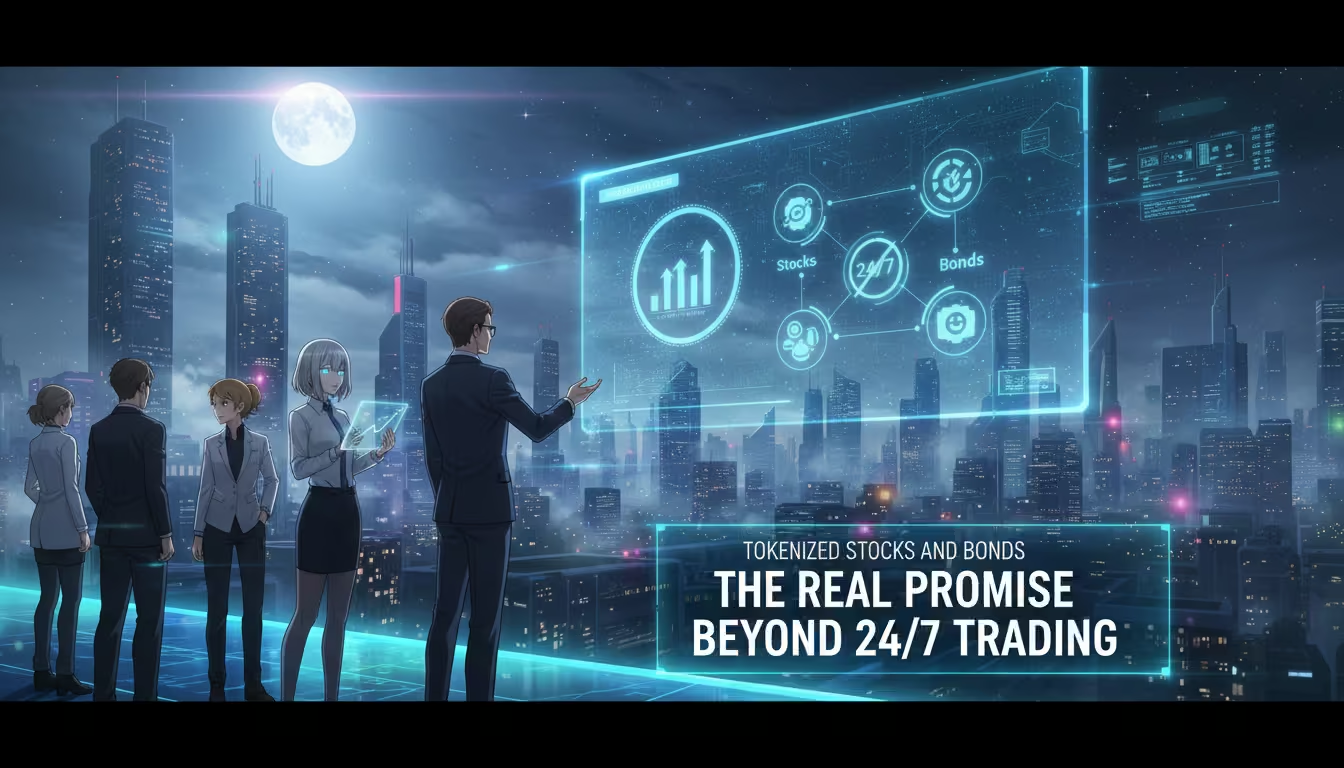
Explore how tokenized stocks and bonds are transforming ownership, liquidity, settlement, and global market access. Beyond efficiency, tokenization is reshaping the future of investing.
Tokenized Stocks and Bonds: The Real Promise Beyond Efficiency
Let’s get through the noise on tokenized stocks and bonds. A lot of the talk is around the obvious stuff 24/7 trading, faster settlements, fewer intermediaries. And sure, those are legitimate benefits.
But if you think that’s the whole story, you’re missing the bigger shift. The real promise of tokenized securities is not just operational efficiency. It’s about re-establishing access, liquidity flows and ownership itself in a digital-first financial system.
Understanding Tokenized Securities and Fractional Ownership
First, let’s get the basics down. A tokenized stock or bond is exactly what it sounds like: a digital representation of a traditional security issued and managed on a blockchain. You’re not buying a “crypto version” of Apple shares you’re buying real economic rights, often through a custodian or a regulated issuer who actually holds the underlying instrument on your behalf. Transfer, settlement and record-keeping are handled by the blockchain layer via smart contracts. Those contracts automate compliance, dividend payments, interest accruals and even voting mechanics. No manual reconciliation. No T+2 settlement lag. No broker back-and-forth.
That’s the elevator speech. But this is what really matters.
Fractional ownership at scale. Yes, fractional shares exist in traditional markets, but they’re clumsy, broker-specific, and often limited to high-volume retail platforms. Tokenization turns fractional ownership native. You can buy $50 worth of a corporate bond or a sliver of a Berkshire Hathaway A share without a lot of hoopla. Retail investors who were priced out before are attracted to that. And it’s not just about small tickets, it’s about portfolio construction. Now anyone can build a diversified portfolio of global securities without six figures or a prime brokerage account.
Related: Introduction to World Liberty Financial Token (WLFI)
Global Liquidity, Settlement Efficiency and Industry Leaders
World-wide liquidity, no gatekeepers. And now for the interesting part. A person in Brazil can buy a tokenized bond issued in Singapore at 2 a.m. local time, settle it in minutes, and hold it alongside tokenized Treasuries. There is no need for an intermediary to approve the trade, no custodian bank to open an account. By default, the liquidity pool is global. Anton Efimenko has a good way of putting it: Deeper order books across time zones dampen idiosyncratic regional volatility. You’re not stuck in a thin market that only opens up during local trading hours. That’s a structural upgrade not a marginal one.
Also noteworthy is Edward Wu’s focus on settlement risk. You wait days for finality in traditional markets. In tokenized markets, delivery-versus-payment can be atomic, with security and cash changing hands in the same block. Counterparty risk plunges. That’s not just convenience, it’s risk reduction that institutional treasuries will price in eventually.
Now, who is actually leading the charge? The competitive landscape is more interesting than people realize.
Crypto-native exchanges and fintech apps have a clear edge. They have already built the wallets, the on and off ramps and the user habits. They don’t have legacy settlement systems to worry about, and their infrastructure is modular. A platform like Backed or Swarm can tokenize public equity in days, not months. But they have trust deficit. Retail investors still ask “Who holds the underlying stock? What if you go broke?” That’s not paranoia. That’s rational skepticism post-FTX.
Traditional brokerages like Fidelity, Schwab or BNY Mellon are slower, but they bring something crypto startups can’t buy: decades of custody expertise, regulatory relationships and brand trust. They have huge balance sheets as well. If a traditional brokerage tokenizes its own stock lending inventory, it’s immediately credible. The question is if they will move fast enough or will wait until fintechs eat their lunch on cross border retail flows.
Relaated: Crypto Market Maturation: Depth, Liquidity, and Stability Explained
My guess is? We’ll see a hybrid model. Crypto firms will provide the rails, traditional players will provide the legal packaging and custody. The first killer use case won’t be sexy DeFi experiments — it’ll be something boring and high-volume, like tokenized money market funds or short-term government bonds. We are already seeing it with the Franklin Templeton and WisdomTree on-chain funds.
Ownership Rights, Legal Risks and Regulatory Challenges
But here’s the part most articles gloss over: ownership rights are not one-size-fits-all.
What exactly are you buying when you buy a tokenized stock? It all depends on the issuance structure. Some tokenized equities offer the full suite of shareholder rights dividends, voting proxies, even access to prospectuses. Others are just economic exposure: you get price movement and distributions, but no governance rights. The marketing frequently muddies that line. Nasdaq’s recent proposals around tokenized asset representations are a direct effort to correct this, advocating for clear labeling so investors don’t get misled into assuming a tracking token is the same as direct registration.
This is not academic. If you hold a token that only tracks the price of TSLA, you will not be allowed to vote at the shareholder meeting. You might not even have a claim in bankruptcy. That’s good if you know that but plenty of retail buyers do not. The industry’s job is to make those distinctions impossible to overlook. Smart contracts can enforce disclosures, but only if the issuer codes it into it.
Legally, tokenization also raises questions about custody, cross-border securities law and insolvency treatment. If your issuer goes bankrupt, is the tokenized asset a security held for your benefit, or just an unsecured claim? We don’t have the same answers yet. Some jurisdictions (Switzerland, Liechtenstein, Abu Dhabi) are ahead with clear DLT laws. Many tokenized stock projects are offered outside the US or structured under Regulation S, as the US is still catching up.
None of this negates the value of tokenization. It just means we have to be honest about the subtleties. The technology is working. That makes economic sense. The friction points are legal and educational, not technical.
The Real Promise of Tokenization and What to Watch Next
So what is the real promise? Tokenized stocks and bonds aren’t going to replace the legacy system overnight. They won’t. But they’ll build out a parallel layer faster, more open, programmable that begins to address the most frictive use cases: cross-border access, fractional high-end debt, 24/7 trading for global retail. Eventually, the two layers will merge. Tokens will be issued by regulated custodians. Traditional exchanges will run matching engines on blockchain rails. The word “tokenized” will simply mean “modern.”
For now, watch two things: who solves the custody + disclosure problem cleanly, and which regulator provides a clear path to retail access. That’s where the real value, and real competition, lives.
Related: IMF on Tokenization: How Digital Assets Are Reshaping Global Finance