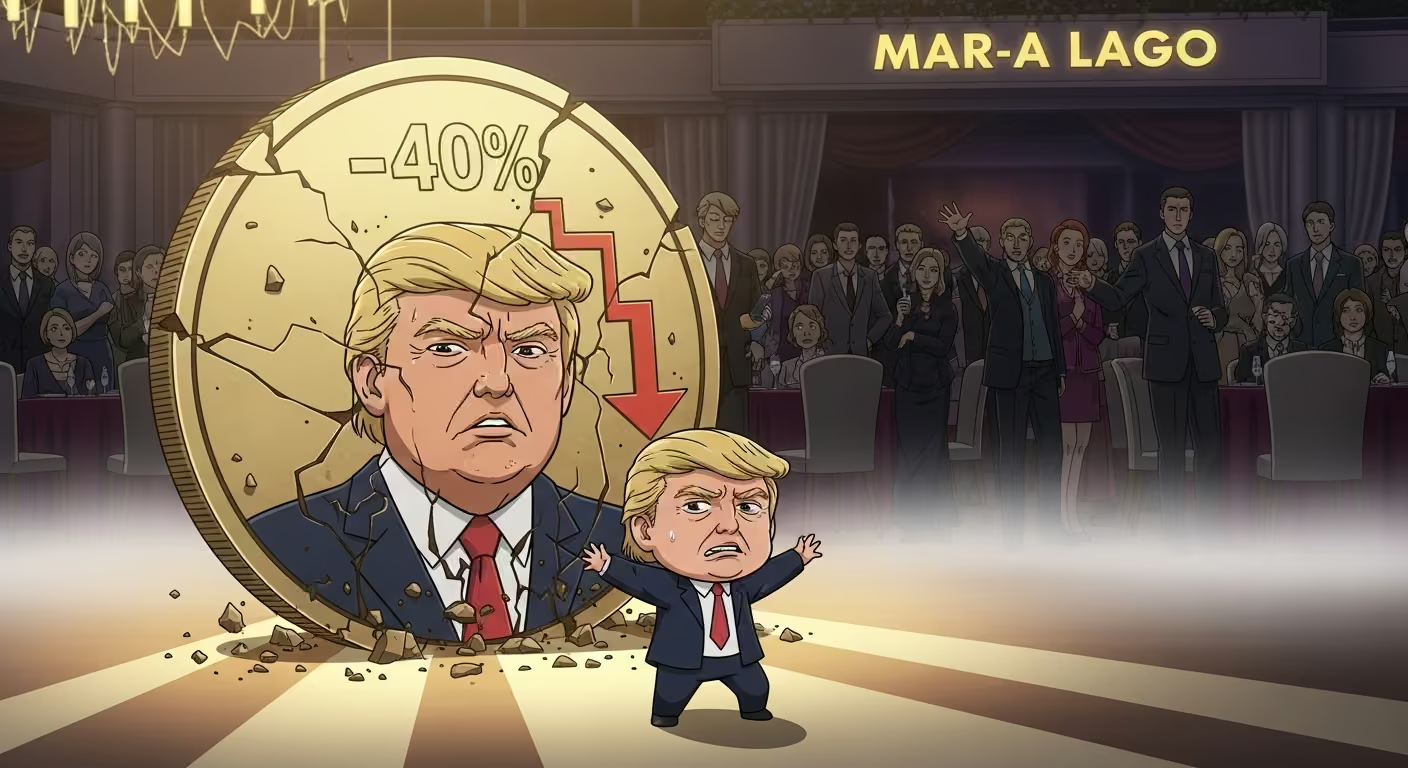

A New York Times investigation alleges the CFTC sidelined whistleblowers who raised concerns about Polymarket, Crypto.com, and Gemini, sparking serious concerns over crypto regulation and political influence.
CFTC Whistleblower Fallout Raises Serious Questions About Crypto Oversight
What the Whistleblowers Really Found
Let’s discuss something that’s not given enough attention: what happens when a financial regulator begins to silence its own staff. The CFTC, the Commodity Futures Trading Commission, has always been seen as the more tech-savvy, pragmatic cousin to the SEC. But a recent New York Times investigation suggests that something uglier is happening inside the agency specifically around how it’s handled whistleblowers who raised red flags on crypto firms with ties to Donald Trump. This is not abstract. We’re talking about career officials who did their jobs. Who looked at platforms like Polymarket, Crypto.com and Gemini and saw real regulatory risks. They were ignored instead of being heard. Suspended. Under internal investigation. And that should be of concern to anyone who cares about market integrity, period.
The CFTC officials were not making fringe complaints. They cited concrete, substantive issues.
Take Crypto.com for example. The concern wasn’t its trading volume or market share. It was about whether the platform was fair to users, whether some bettors or traders had asymmetric advantages. Fair treatment in derivatives markets is not a good to have. It’s the law.
Then there’s Polymarket. The whistleblowers cited inadequate fraud prevention measures. Insufficient fraud controls are not an operational flaw, they are an invitation to abuse for a prediction market that handles real money on high-stakes events. If you are unable to detect wash trading or coordinated manipulation your market data is noise. And Gemini? The trouble there was an affiliate that allegedly bypassed required regulatory reviews. That’s not gray. To skip review processes for new products or structures is precisely the sort of thing that lands firms in serious trouble unless, it appears, the regulator turns a blind eye.
But here’s the kicker: rather than acting on these concerns, the CFTC acted against the people who raised them. Administrative leave. Internal probes The message was clear: Keep your head down.
Related: Coinbase Legal Fight Over Prediction Markets
Enforcement Numbers Don’t Lie
Let’s zoom out. The current administration has seen a sharp decline in enforcement activity from the CFTC. The agency averaged over 80 enforcement actions per year in recent years. Last year? Two. Just two. That’s not a statistical fluke. That’s a policy change. And the pattern is important. The CFTC’s cases tend to go after smaller players, individual or minor entities, but the bigger firms, in particular those with political connections, tend to get a lighter touch. It’s more than a bad look. It destroys the whole idea of fair-market supervision.
You can’t say you’re protecting market integrity when you’re just going after the little guys.”The problem has some structural aspect. Some of the CFTC’s key people have past ties to the crypto industry. That’s not automatically disqualifying, domain expertise matters. But when those same people are making enforcement decisions about former colleagues or companies with political connections, the optics are awful. And optics matter in regulation, because trust is the currency regulators deal in
We have been here before. Enforcement begins to be scaled back. Whistle-blowers are silenced. Low-risk targets are the focus of enforcement. And the public slowly begins to see the watchdog has been neutered from the inside. The CFTC’s recent legal assault on states seeking to regulate their own prediction markets only deepens the muddle. The agency, on one hand, is trying to hold onto federal control over these products. But it’s also suspending employees who tried to enforce the rules already in place. That’s not a strategy, that’s institutional whiplash.
Related: Prediction Markets Under Fire: Congress Investigates Kalshi, Polymarket & Insider Trading Risks
Trump’s Connection to Polymarket
Let’s get specific about the political angle, because it’s central to the story. Polymarket has been well-documented to have financial ties to Trump-affiliated people and businesses. That doesn’t make it illegal. But it establishes an incentive system where heavy CFTC oversight of Polymarket could be spun as political, and where leniency might be rewarded. This was what the whistleblowers knew. They weren’t making political accusations. They were saying that some crypto firms, regardless of where they fell politically, were operating in ways that violated basic regulatory rules. And they were billed for it.
Why This Matters Outside the CFTC
This has a chilling effect. If employees at a major financial regulator know that raising good-faith concerns leads to suspension and investigation, they will stop raising concerns. That’s not speculation. That’s simple human behavior. And when the internal dissent dies, the regulatory capture thrives.
“Other agencies are watching.” SEC. The OCC FDIC. If the CFTC can get away with silencing whistleblowers, what’s to stop anyone else from doing the same?
Related: Trump-Backed Crypto Project Faces Alleged Coordinated Attack
The Bottom Line
We don’t need regulators to be tougher in word. We need independence. The CFTC’s job isn’t to favor big firms, political friends or any other constituency. Its job is to apply the rules fairly, transparently and with neither fear nor favour. The staff who asked questions about Polymarket, Crypto.com and Gemini were doing that job. They got suspended for their troubles.
That’s not a bug in the system. “That’s a sign the system is broken.” And until congress or public pressure demands a real reckoning, the message to every other regulator will be clear: keep your head down, or lose your career.