
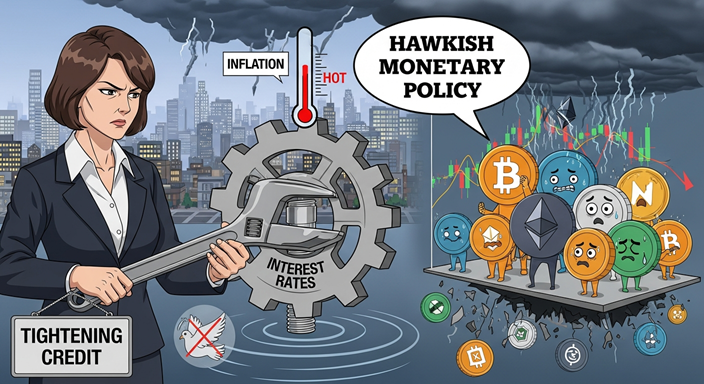
What does it mean when someone says “hawkish monetary policy”?
When central banks focus on keeping inflation in check, they are following a hawkish monetary policy. They do this by making it a little harder to get money. In real life, this usually means raising interest rates, making it harder to get credit, and making it harder to get money. The main goal is to keep inflation from getting too high. This helps keep the currency’s buying power and the economy stable.
When the economy is “hawkish,” it can feel “hot,” and inflation can rise. When the central bank raises interest rates, it costs more to borrow money. That makes people spend less money and businesses invest less. So, stricter rules can have big effects, even on the market for cryptocurrencies. When rates go up, the opportunity cost of holding risky assets like cryptocurrencies goes up, which can make people less interested in them.
On the other hand, dovish monetary policies try to boost growth. Usually, they mean lower interest rates and more money moving around in the economy. Dovish policies push people to spend and invest more to help the economy grow. On the other hand, hawkish policies try to keep inflation in check to protect long-term stability and prosperity. These methods can have a big effect on markets, including how investors see cryptocurrencies, which are often seen as alternative assets in a changing economy.
To predict how changes in interest rates will affect different markets, including the growing field of cryptocurrency, investors and other interested parties need to know what hawkish policy is and how it affects the economy.
The Connection Between Hawkish Monetary Policy and the Cryptocurrency Markets
The link between hawkish policy and crypto markets is becoming more important as central banks around the world take stronger steps to fight inflation. A hawkish stance, which usually means higher interest rates and a tighter money supply, can change how investors treat digital currencies in big ways. Investors may be more careful and move money away from high-risk assets like cryptocurrencies when borrowing costs go up.
Changes in policy tend to make the crypto markets more unstable. When there is less liquidity, prices can change more as traders deal with tighter financial conditions. Some investors may see cryptocurrencies as a way to protect against inflation or as a place to store value, especially as fiat currencies lose value. In a tightening environment, this view can draw in some buyers looking for a way to protect themselves from inflation, even though crypto assets have their own risks. In the end, the link between hawkish policy and the crypto markets is not clear. Investors should keep up with how changes in policy can affect both traditional and digital financial systems.
Related:What You Should Know About IPOs in Crypto and Finance
How Hawkish Policies Affect Altcoins: Case Studies
Hawkish monetary policies, like higher interest rates and stricter control over the money supply, have had a big effect on the crypto market for a long time, especially altcoins. Looking at the past can help us understand how these rules affect different digital assets. For example, when the U.S. Federal Reserve took a tougher stance in 2018, the crypto market became very unstable. Bitcoin and a lot of other altcoins fell as investors became worried about a slowing economy. But some niche altcoins with strong fundamentals or unique value propositions held up well or even did better during that time.
Ethereum (ETH) is a good example. Even though things were pretty hawkish around 2020, ETH did pretty well because a lot of money went into decentralized finance (DeFi) projects that were built on its network. That shows how a coin’s fundamentals and use cases can help it get through tough times with money.
Smaller or less well-known altcoins, on the other hand, often have a hard time when policy is hawkish. Some initial coin offerings (ICOs) and newer projects failed because interest rates were going up and the economy was uncertain. Market reactions can quickly change how people feel about crypto assets that are thought to be safer bets.
When you look at these cases, the relationship between hawkish policy and altcoin performance isn’t clear-cut. Expect more ups and downs in the short term, but coins with strong fundamentals and good value can still do well.
Related:Because the government is shut down, altcoins like Solana and Dogecoin will have to wait longer for U.S. ETF approval.
The future: Economic Growth and the Cryptosphere
The changing nature of monetary policy, especially a hawkish stance from central banks, has big effects on both the traditional economy and the cryptosphere. When rates go up to fight inflation, it costs more to borrow money. This can slow down consumer spending and business investment, which could slow down overall growth.
A long period of hawkishness could make it harder for cryptocurrencies to be widely used. In a high-rate environment, traditional investments with steadier returns may look more appealing, which could cause people to move money away from riskier assets like crypto. That could make it harder for the sector to grow and come up with new ideas.
The crypto market, on the other hand, has proven to be strong and flexible. Changes in regulations and financial policies may lead to new kinds of innovation that focus on stability, compliance, and ease of use. Stablecoins could become more popular as a way to connect traditional currencies with new digital assets, for example. Changes in rules and policies could lead to new opportunities for users to take part in decentralized finance (DeFi) platforms.
In general, the connection between hawkish monetary policy and the cryptosphere will keep having an effect on the economy as a whole. Anyone who wants to get involved in both traditional and digital finance should keep an eye on interest rate expectations and what they mean, as well as how well the crypto market can handle regulatory and economic problems. In short, people who want to take advantage of opportunities in both areas should pay close attention to how changes in policy affect growth, risk, and innovation in the crypto space.