By CoinGSM News Desk | Crypto Industry Insights
Introduction
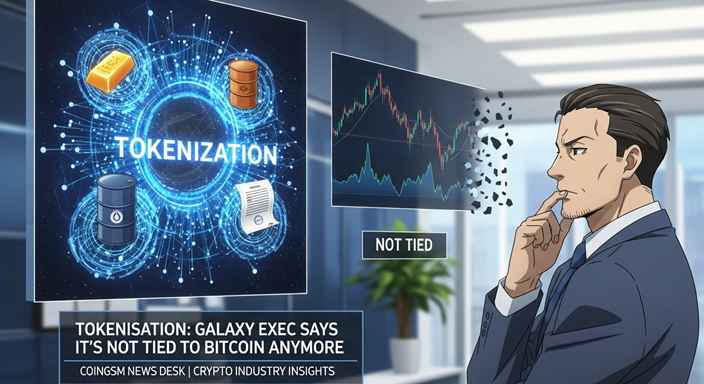
Thomas Cowan, who is in charge of tokenisation at Galaxy Digital, says that people are interested in tokenising assets for more than just Bitcoin’s price changes. Over the past few months, institutions have begun to see tokenisation as a benefit of blockchain on its own, not just as a response to Bitcoin’s price movements.
Tokenisation Gaining Independence
Cowan spoke at The Bridge conference in New York City and said that there is a growing gap between people’s interest in tokenisation and Bitcoin’s market moves.
In the past, rising crypto prices would cause a lot of excitement about tokenisation, but that excitement would fade when prices fell. Cowan thinks the trend has changed today: tokenisation is still popular, no matter what the price of Bitcoin is.
He said, “Interest in tokenisation is not linked to Bitcoin’s price.”
He noted that traditional banks have added crypto and tokenisation features, and that teams tend to get smaller when the economy is bad. Now, he sees momentum building on its own, as stakeholders see how blockchain can move and store traditional assets safely.
The Rise of Tokenisation
Over the past year, tokenising real-world assets like oil and bonds has grown a lot. The situation includes changes in regulations that have made some crypto rules less strict, which has led to more involvement from big financial players.
Bitcoin reached its highest point of about $126,000 in early October, but then it dropped by about $20,000. Institutional interest in tokenisation has stayed strong.
A Longer Time Frame for Using Crypto
Cowan hopes that by 2025, institutions will see more clearly that tokenisation is a faster, cheaper, and better way to move and store money.
For big companies that think in decades, the choice to use tokenisation depends on clear, long-lasting benefits and a feeling that the trend is unavoidable.
He stressed that tokenisation could be the back-end structure for big banks.
The Rise of On-Chain Money Markets and Stablecoins
Cowan said that stablecoins are a key use case that is growing quickly, especially since this year when the rules became clearer.
He said that there is more interest in tokenised money market funds, which invest in things like government bonds, as more money moves on-chain.
He said that when money moves to blockchain networks, investors look for the stablecoins’ usual risk-free rate.
He said that the natural next step is to go from stablecoins to tokenised money market funds.
A Turning Point for the Industry
Cowan said that the industry is getting close to the point where technology can show big banks that it is worth their time to get involved.
He said that we should be patient and look for proof before investing, and he said that now is the time to invest because adoption is coming soon.
The State of the Industry
The article also talks about different points of view and makes random references to the larger tokenisation and crypto space. For example, it talks about the growth of the real-world asset (RWA) tokenisation market and mentions big names like Galaxy Digital.
It talks about estimates of the size of the RWA tokenisation market, which show that it has grown a lot since 2022.
It also talks about how tokenisation could make transactions easier, more transparent, and more liquid.
Things to Remember
- There is less and less of a connection between tokenisation and Bitcoin’s price changes.
- As companies build strong capabilities for tokenised assets, institutional involvement in tokenisation is growing.
- People think that stablecoins and tokenised money market funds are the next logical steps in on-chain finance.
- The industry is getting close to being able to show big banks that blockchain-based tokenisation is worth a lot in the long run.
- The market for tokenising real-world assets is getting bigger because of changes in the law and the appeal of on-chain efficiency.
One thought on “Tokenisation: Galaxy Exec Says It’s Not Tied to Bitcoin Anymore”