
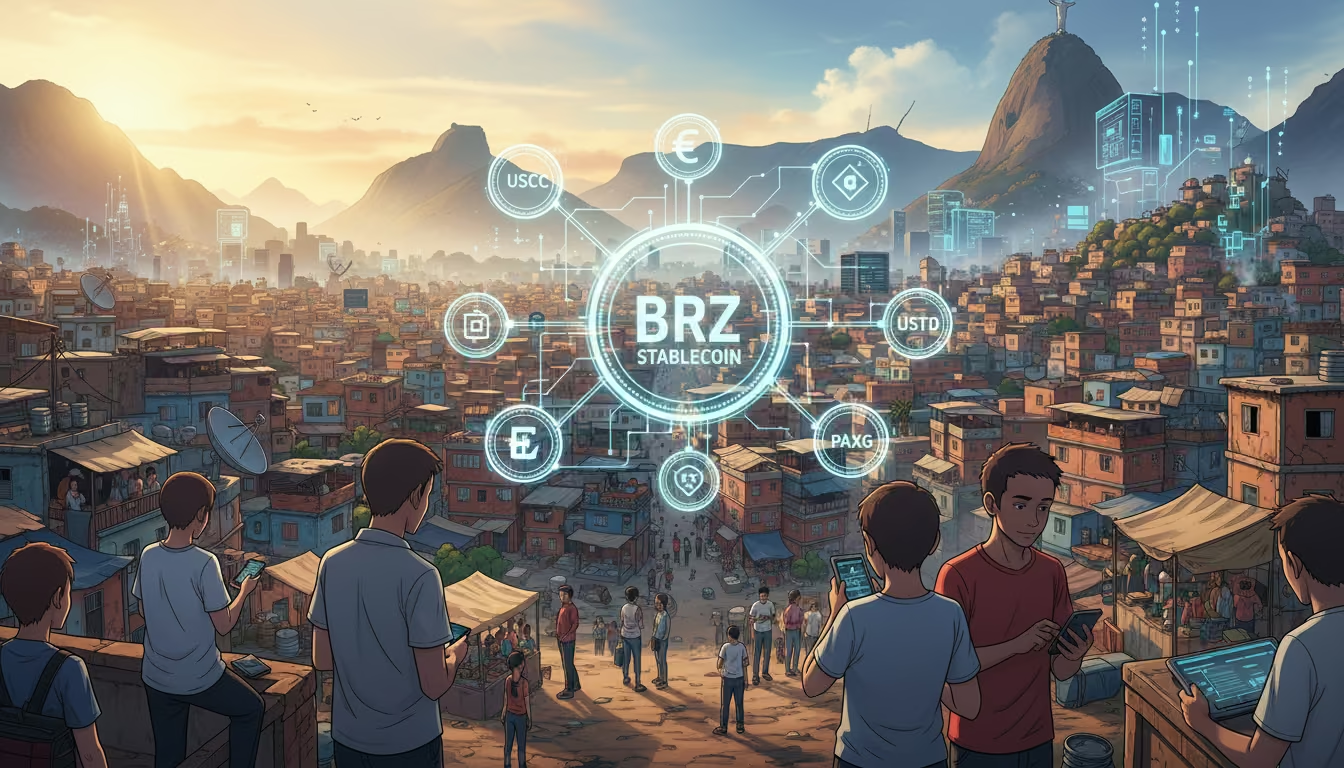
Brazil’s stablecoin adoption is accelerating as digital assets reshape savings, payments, and financial infrastructure, while regulators and the IMF assess the risks and opportunities for the country’s economy.
Brazil’s Stablecoin Boom: A Reality Check From The Ground
Let’s be blunt about what’s happening in Brazil right now: the stablecoin market isn’t just growing, it’s becoming a foundational pillar of the country’s financial plumbing. We’re long past the “early adopter” phase. What we have seen since 2017 is a structural change, driven by a very real, pragmatic need for a stable store of value in an environment where the Brazilian Real has been under constant pressure.
At its heart, the driver here is very simple. When you are facing local currency volatility that can wipe out purchasing power in a matter of months, a dollar-pegged digital asset ceases to be a speculative instrument and starts to look like a savings account. It is a rational hedge. But there’s more to the story than capital preservation. We are seeing stablecoins being used as an important commerce tool to facilitate faster and cheaper cross-border settlements. For a country with a high volume of remittances and a dynamic international trade, this is not a novelty it is a competitive advantage.
Related: Stablecoin Payment Rails: How Tether, Circle, and Fintechs Are Reshaping Transactions
This fast uptake is driven by a surge in digital financial inclusion. With high mobile penetration and increasing access to the internet, a large section of the population can now move around traditional banking hurdles and directly tap into global pools of liquidity. Big financial players, from traditional banks to fast-moving fintechs, are watching closely and exploring integration. This is not just about developing new products but about defending market share in a rapidly digitising economy. The momentum is undeniable, and points to an evolution in the very fabric of how Brazilians transact.
IMF Warnings: Reading Between the Lines
The International Monetary Fund (IMF)’s recent review is not just an academic curiosity, it’s a sign. But it’s an evaluation that is worth a closer look. The main takeaway is that Brazilian stablecoin transactions are more sensitive to global macroeconomic shocks than traditional assets. This is a significant nuance.
So, here’s how to think about it. A stablecoin is supposed to track the dollar, but the ecosystem around it liquidity pools, DeFi protocols, arbitrage mechanisms is highly sensitive to global risk sentiment. This is a new channel for transmission of external volatility,” said IMF economist Alejandro Werner. Sudden shifts in global liquidity or a crisis in U.S. money markets could cause rapid outflows or inflows in the Brazilian crypto market which could put pressure on the exchange rate of the Real in ways we have not yet fully modeled. The problem with stablecoins isn’t that they’re volatile, it’s that they’re part of a system that is a vector for instability.
This has direct consequences for monetary policy. A material share of transaction activity moving to dollar-denominated digital assets could also hinder the central bank’s ability to effectively transmit its policy through the traditional banking system. The IMF is right to advocate a regulatory framework that is forward-looking and flexible. This involves looking beyond simply recording trades, to systemic interdependencies, the dynamics of capital flows, and the possibility of liquidity squeezes spilling over into wider financial markets.
The Regulatory Tightrope
The Central Bank of Brazil has been ahead of the curve, establishing the first guidelines and accepting cryptocurrencies as a legal means of payment, but the regulatory framework is still being built. The 2021 guidelines were a necessary first step but they are largely institutional guidelines. The real work is still to be done.
The challenge isn’t to prove that stablecoins exist, it’s to set the rules of engagement for stablecoin issuers. The existing gaps in customer protection are huge. Retail users can be vulnerable to fraud or operational risk with little legal recourse in a peer-to-peer transaction market with decentralized exchanges. Similarly, there are AML/KYC requirements for exchanges but the traceability of funds once they go into decentralized protocols creates a blind spot which regulatory authorities are struggling with.
The industry is seeking clarity. Clear and complete rules on reserve audits, redemption rights and operational transparency for issuers would not only protect consumers, but also promote a healthier, more credible market. Without that, you risk a “race to the bottom” where the most complaint players are undercut by those operating in a grey area, potentially damaging the reputation of the whole ecosystem.
The Future Intertwined: Finance, Policy and Innovation
In the future, the coupling of crypto, and stablecoins in particular, with Brazil’s traditional finance is only going to get deeper. The Central Bank’s work in building an open finance framework and a potential digital real (Drex) indicates a strategic vision where digital assets are integrated into a more efficient, interoperable financial system.
“Cross-border payments using stablecoins could be a game changer for Brazilian companies. It holds the promise of a possible shortcut to a more efficient global payments system, reducing transaction costs and settlement times for cross-border trade. The aim is to create a modern, agile financial infrastructure that makes the Brazilian economy more competitive and attractive to foreign investment.
Related: Trace Finance’s $32M Raise Signals a New Era for Stablecoin Cross-Border Payments
But the road ahead calls for careful and ongoing calibration. “It should be an ongoing dialogue between the regulators and the traditional financial players and the new fintech and DeFi protocols that are pushing the envelope.” It’s about building strong frameworks so that you can contain systemic risk without killing the innovation that makes this space so attractive.
Within this context, Brazil can be a world reference. Its stance on stablecoins could serve as an example for other emerging markets facing comparable economic pressures. The decisions that will be made in Brasília in the next few years will not only determine Brazil’s economic future, but also send a strong message to the world’s crypto ecosystem that integrating digital assets into the core of a large economy is possible.