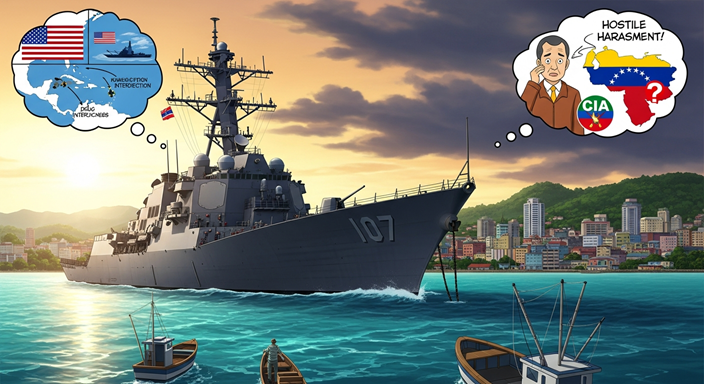
What the Arrival of USS Gravely Means for Security in the Area
The USS Gravely arrived in Port of Spain, Trinidad and Tobago, on [insert date]. This was a big deal for maritime security in the Caribbean. This arrival shows that the United States is committed to working with other countries in the region, and it also shows how the security situation in the Caribbean is changing.
The USS Gravely is an Arleigh Burke-class guided missile destroyer that has advanced features that help the U.S. Navy’s strategy in this important area.
The main goal of the USS Gravely while it is in Trinidad and Tobago is to train with the local military. These joint efforts make both the U.S. Navy and Trinidadian forces more ready for action, which leads to better interoperability and better ways to respond to new threats. In the end, this kind of training makes local security forces stronger, so they are better able to deal with possible problems like drug trafficking and piracy.
This deployment also reflects a broader U.S. strategy focused on countering the influence of Venezuela in the Caribbean. The recent tensions in and around Venezuela make people worried about the stability of the region, so the U.S. Armed Forces are keeping a close eye on things. The USS Gravely’s presence makes it clear to both friends and enemies of the United States that the country is ready to act to protect shared interests.
The expected arrival of the USS Gerald R. Ford aircraft carrier in the area also shows how the U.S. military presence has grown, adding to the overall story of deterrence in the Caribbean. This powerful navy protects allied countries and shows that the U.S. is serious about keeping peace and stability in waters that are important for national security and the economy.
In general, the USS Gravely’s arrival may mark a new phase in Caribbean security cooperation.
Venezuela’s Worry: What to Do About U.S. Military Moves
The docking of the USS Gravely in Trinidad and Tobago has made the Venezuelan government very nervous. They see it as part of a larger plan by the U.S. military to show off its power in the Caribbean. Venezuelan officials have called these actions hostile harassment, which means that they see them as a threat to the country’s independence.
The words coming from Caracas show a long-standing distrust of American motives, especially when it comes to Venezuela’s rich natural resources, which are seen as important for both domestic and foreign interests.
Venezuelan leaders have often said in official statements that the U.S. uses its military power to destabilise the region and cause problems within the country. This has led to a common story that the USS Gravely’s presence isn’t just a naval exercise but could also be a sign of interventionist tactics aimed at bringing down the current government. The government’s response shows a mix of nationalism and fear as it tries to bring people together against what it sees as imperialist aggression.
Also, scary theories have come up in Venezuelan discourse that suggest that U.S. intelligence agencies, especially the CIA, are behind secret operations disguised as military movements in the Caribbean. Reports of false-flag operations often make these theories stronger, which makes people more afraid that outside forces will get involved in Venezuelan affairs.
The government uses these stories to get people to support its policies and to get people to feel strongly about them. It frames these military actions as bad for both Venezuela and the stability of Latin America as a whole.
In the end, the anxiety in Venezuela is caused by a complicated mix of past problems and current geopolitical events. As U.S. military operations persist in the region, the ramifications for Venezuela are significant, with escalating tensions expected to affect both domestic policies and international relations in the near term.
Legal Arguments in the U.S. and Congressional Views on Military Interventions
The recent placement of a U.S. warship in Trinidad and Tobago has led to a lot of debate in the U.S. Congress about whether military interventions in the Caribbean are legal and necessary. These talks are mostly about drug interdiction, which is a very important issue that has made people pay more attention to military operations that are said to be fighting drug trafficking.
Lawmakers are becoming more divided over how big and powerful the military should be in these missions — a sign of the bigger ideological divides that are affecting U.S. foreign policy today.
Some members of Congress want the military to be more aggressive. They say that the worsening situation in Venezuela, especially the influence of Nicolás Maduro’s government, requires stronger U.S. intervention to stop drug-related activities that some say are being used as an excuse for regime change.
This group often says that the drug trade is linked to the geopolitical struggle in the region. They say that fighting traffickers serves two purposes: it helps with narco-trafficking problems and it supports U.S. interests in promoting democracy in Latin America.
On the other hand, some lawmakers warn against a broad interpretation of military power. They are worried that calling drug trafficking a threat to national security could give the military too much power and lead to more conflicts that could make things worse.
These representatives say that diplomacy and working together with regional partners are better options than getting directly involved in the military. They stress the importance of carefully considering the effects of military actions, saying that these kinds of actions could unintentionally help authoritarian governments or make the region less stable than planned.
As the talks go on, the complicated stories about drug trafficking and military involvement show how hard it is for Congress to come up with a unified response. The disagreement among lawmakers shows how important it is to take a balanced approach that takes into account both security issues and the long-term effects of military actions in the Caribbean.
A Volatile Regional Chessboard: The Complicated Interactions at Work
The Caribbean has become an important place for geopolitical maneuvering, especially since the U.S. Navy has been operating near Trinidad and Tobago recently.
Putting a U.S. warship in this important spot isn’t just a show of military power; it also shows how tensions have been building and how the region’s complicated dynamics have changed over time. Many people see the operation as a direct threat to Venezuela, especially since President Nicolás Maduro sees it as a violation of the country’s sovereignty.
The United States says that its navy is there to keep the seas safe and stop drug trafficking, but these reasons often hide the real reasons, which may include stopping Venezuela’s influence. Maduro’s government has always been worried about what they see as American military assets encroaching on Venezuela’s sovereignty and territorial integrity.
This point of view shows how complicated the relationship is between military dynamics and national sovereignty in the area. It creates a fragile balance where misunderstandings can make things worse.
These military developments have effects that go beyond just the two countries involved and affect the whole Caribbean geopolitical landscape. When tensions rise between the U.S. and Venezuela, countries in the region often find themselves in the middle. This causes alliances to break down and diplomatic ties to be re-evaluated.
Even though relations between Washington and Caracas seem weak, there is a strong need for communication to avoid possible military conflicts. Both sides need to be very careful in this unstable situation because mistakes could have big effects on the stability of the region.
As things happen, the possibility of changes in alliances and diplomatic strategies will shape the future of Caribbean geopolitics. In this region, military posturing and political rhetoric can quickly change the way countries work together and fight each other.
The tension around U.S. naval operations is a reminder that the Caribbean is still a complicated chessboard, where every move has consequences and is full of risk.