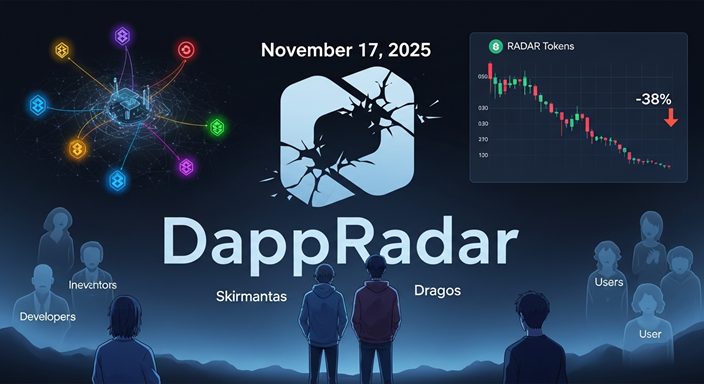
DappRadar will close on November 17, 2025, because it has been having trouble with money and can’t keep running. The announcement ends a platform that has been tracking decentralized apps on many blockchains since 2018 and has served millions of users and thousands of developers who relied on its information.
The founders, Skirmantas and Dragos, said that questions about the DAO and the RADAR token would be answered separately. They also said that the community would be able to give feedback during the wind-down process. Their message stressed that the company should be careful and open as it gets closer to closing.
A Look Back at DappRadar’s Rise
DappRadar became a trusted source for blockchain data after the CryptoKitties wave, which was a defining moment for the company. At its peak, the platform provided analytics for hundreds of blockchains and included things like transaction activity, trades, and user engagement. It became the place to go for developers, investors, and analysts who wanted to see decentralized apps, finance, gaming, and NFT markets from a cross-blockchain perspective.
Why the Platform Couldn’t Survive
But even though it was successful at first and widely used, it couldn’t keep growing financially. The co-founders’ notes made it clear that the business model couldn’t keep up with rising costs and changes in the market. They stressed that they would be honest about the end of the project, including how the DAO and RADAR token issues would be handled in the future.
The shutdown has a big effect on a world where DappRadar used to be very important. It became a center for cross-chain analytics by bringing together data from more than 50 blockchains and giving information about network activity, market changes, and platform performance. The financial model couldn’t last as the crypto market changed due to volatility, changing user needs, and changing infrastructure needs.
Market Impact and the RADAR Token Reaction
After the news, RADAR, the token that goes with the platform, lost 38% of its value. The company said again that information about the DAO and token would come out at a different time. This shows that they have a careful and responsible plan for shutting down.
Industry-Wide Implications
The choice to close has big effects. Changes will affect people who used real-time data feeds, developers who built on the analytics ecosystem, and holders of RADAR tokens. The closure could force developers and analysts to look for other data sources or switch to different analytics tools, which could change how they work and make decisions.
DappRadar’s departure leaves a big hole in multi-chain analytics in the larger industry. There are still big players and focused explorers in the space, but DappRadar’s unique value was that it gave a unified, cross-chain view of decentralized applications and markets.
Crypto Market Conditions Made It Even Harder
This moment comes at a time when the crypto industry is changing quickly. In 2025, the overall digital asset market crossed the $4 trillion mark, but many companies still had trouble making money. This was especially true for analytics providers, who had to deal with high infrastructure costs and few ways to make money. Market research shows that the crypto trading platform space is growing quickly, but this growth is mostly due to trading activity, not analytics services. This makes it harder for businesses that rely on analytics to stay in business.
The ecosystem also has to deal with technical problems. Chain forks and stale blocks can hurt the quality of data, and the fact that different blockchains don’t work together makes unified analytics harder. Because there aren’t many ways to make money that balance out these costs, they keep going up, especially as free tools become more common.
A Seven-Year Legacy and What Comes Next
DappRadar’s seven-year run shows both the potential and the risks of building basic blockchain infrastructure in a market that changes quickly. As the industry thinks about the next wave of analytics solutions, the end of a once-important player shows how blockchain data services are still struggling to find a balance between innovation, value, and long-term viability.