By CoinGSM News Desk | Layer 2 & Token Sale Updates
Aztec Network’s New Approach to Token Distribution
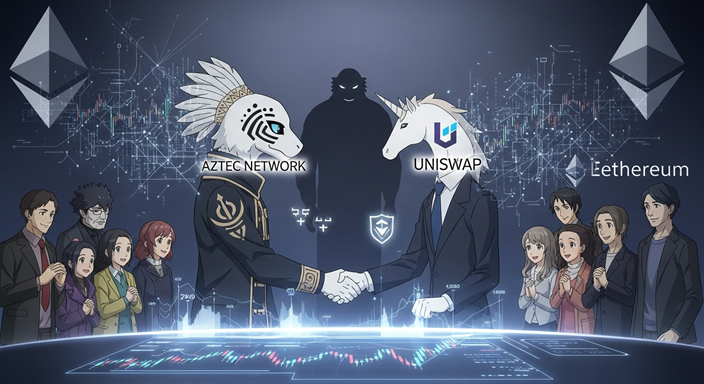
Aztec Network is changing its token sale by teaming up with Uniswap’s newest auction system. The privacy-focused Layer 2 on Ethereum has begun accepting registrations for the sale, which starts today at 3 p.m. CET.
The Continuous Clearing Auction (CCA) from Uniswap Labs is what makes this sale different. With Aztec as a key contributor, this new auction system aims to make token distribution more open and available to more people.
Why Aztec Chose CCA Over a Traditional Airdrop
According to Aztec’s team, CCA is a big step toward making things fair.
Co-founder Zac Williamson says that the old way of doing things often helps insiders and whales. He says that CCA can level the playing field by making sure that everyone in the community can access it and find fair prices as people help build the network’s decentralized staking and governance.
Aztec’s sale uses CCA instead of a typical airdrop to give everyone a fair chance to participate, make it easy to find the right price, and give community members a clear way to get involved.
The distribution starts with a starting floor price based on a $350 million fully diluted valuation (FDV). This means that the price is much lower than what Aztec Labs’ most recent equity financings suggest the network is worth.
The process has per-user caps to make sure that everyone has a fair chance to bid and compete. The goal of CCA is to help retail bidders get around the usual problems that come up when big holders or institutions control the market.
Zero-Knowledge Technology and Privacy-First Verification
Joe Andrews, the President and Co-founder of Aztec Labs, says that they have been working with Uniswap on the CCA protocol for months.
He goes on to say that this is the first time something like this has happened with Ethereum, thanks to ZkPassport’s Noir circuits, which allow zero-knowledge proofs to be used in sale contracts.
This privacy-first approach makes sure that sanctions checks can be done without revealing private information.
People who have been in the community for a long time will be able to place bids early on November 13, 2025, at 3 pm CET.
The main public bidding window will be open from December 2 to December 6, 2025.
People who are interested can go to the sale site to check their eligibility and mint a soulbound NFT that proves they have the right to participate. Readers can find more information in Aztec’s whitepaper.
What Is the Aztec Network?
Aztec calls itself Ethereum’s privacy-native Layer 2. This lets developers make apps that protect users’ privacy while still following the rules on the blockchain.
The project has raised $100 million in a Series B round led by a16z.
Researchers and cryptographers who were the first to create trustless client-side proving are behind it.
This is a big step forward for privacy-focused apps on mobile devices.
Aztec makes a scalable privacy layer for the decentralized future using zero-knowledge proofs and Noir, a programming language that is similar to Rust.
What Is the Aztec Foundation?
The Aztec Foundation helps the Aztec Network grow and supports open-source programmable privacy.
The Foundation is in charge of the protocol. It pays for basic cryptographic research, helps developers make apps that protect users’ privacy and follow the rules, and keeps Noir running.
It also takes part in community governance, technology decisions, and protocol operations.
The announcement goes on to say that the token sale is a big public offering that is part of Aztec’s larger plan and that it is meant to focus on real-time price discovery and fair access.
The plan includes making soul-bound NFTs to prove that people took part, and more than 300,000 addresses were allowed to bid on the first day.
People from all over the world, including the United States, can buy things at the sale.
How the Auction Works & Token Economics
The sale is based on Uniswap v4’s Continuous Liquidation Auction framework.
Aztec added a ZK Passport module so that people could participate privately and with proof.
A part of the total AZTEC supply will be set aside for the sale.
Early numbers show that a significant amount will be set aside for the distribution event and for providing liquidity afterward.
The Genesis token supply is made up of 10.35 billion AZTEC tokens that are spread out among investors, the core team, the Foundation, ecosystem grants, and different sale allocations.
The sale part makes up about 22% of the total supply.
After the sale, tokens will be given to contributors and genesis bidders.
The foundation plans to give a large number of tokens to the Uniswap v4 pool to help keep it liquid.
The liquidity is locked in a smart contract for at least 90 days. After that, governance can decide when to release it.
Token use cases include staking sequencers, taking part in Aztec governance, and possibly being used as a way to pay transaction fees if the execution environment is turned on in a future governance upgrade.
A Look Back at Aztec’s Journey
Aztec’s journey includes a seed round in 2018, a follow-on in 2019, and the launch of the mainnet in 2020.
This was followed by a Series A in 2021 led by Paradigm and a Series B in 2022 led by a16z.
The company has gone through changes, like ending Aztec Connect in 2023 and changing how it handles DeFi privacy bridges.
However, Aztec’s public testnet phase started in May 2025.
It’s worth noting that the current token economics show that there was no separate airdrop share for participants, even though that was expected.
Since the boom in late 2021, the crypto market as a whole has cooled off.
The talks about Aztec’s token sale show that people are still unsure about how price discovery, fairness, and long-term value will work in practice.
As Aztec moves forward with its fair-access auction, people who follow the market will be very interested to see how the model works to get a lot of people involved, protect their privacy, and provide real liquidity.