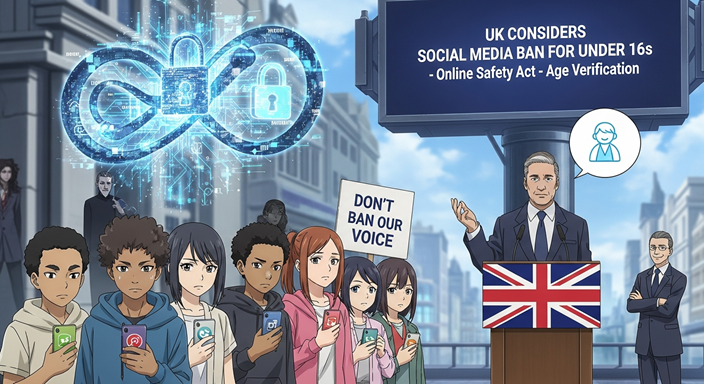
The UK is thinking about making new rules that could stop kids under 16 from using popular social media sites. This shows that the country is taking a stronger stand on online safety and age verification.
The proposal builds on the UK’s Online Safety Act, which already says that digital platforms must enforce minimum age limits and use “highly effective” age-assurance measures where kids could see harmful content.
Prime Minister Keir Starmer said that the UK government is keeping a close eye on how Australia’s ban on social media for kids under 16 works and is open to doing the same thing in the UK, even though there were concerns about putting a blanket ban on teens.
Support for stricter controls has come from all sides of the political spectrum. David Davis, a Conservative MP, spoke out in favor of a ban, saying that social media is bad for kids and that schools shouldn’t allow cell phones.
More and more pressure is being put on social media sites.
Regulatory Pressure and Free Speech Concerns
The debate comes at a time when UK regulators are cracking down more on the Online Safety Act. Ofcom, the UK agency that watches over online safety, is getting ready to use stronger powers against platforms that don’t follow rules about child safety and illegal content. These steps could include big fines or even limits on access.
Elon Musk owns the social media site X, which has already had problems with UK authorities. They warned that strict enforcement could hurt free speech. Some people who don’t like the Act say that stricter controls could lead to censorship and too much government control over what people say online.
Aleksandr Litreev, the CEO of Sentinel, a decentralized VPN provider, said that limiting young people’s access to online platforms could hurt their ability to think critically and understand technology. He said that these kinds of policies could lead to the same kinds of restrictions that are happening in China, Russia, and Iran.
The world is moving toward verifying age and identity.
The UK isn’t the only country that is tightening digital controls. Australia has made new rules that say major search engines must check the ages of their users using methods like government IDs, biometrics, or payment verification. These rules will start to be enforced in late 2025.
Ireland is also pushing for social media accounts that can be verified by identity across the EU. It plans to bring this up during its presidency of the EU Council in 2026.
The UK government recently dropped plans for a centralized digital ID system for right-to-work checks because people were worried about privacy.
What This Means for KYC and Crypto
As governments start using age and identity verification in more than just financial services, similar technologies are showing up more and more on consumer platforms. Crypto exchanges already have strict Know Your Customer (KYC) rules that say you need to show ID, scan your face, and prove your identity with biometrics.
The growing push for online identity checks means that digital verification tools could soon be standard on social media, search engines, and other online services.
Critics say that even though these steps are often called safety measures, they could have a big impact on online privacy and digital freedoms in the future.