
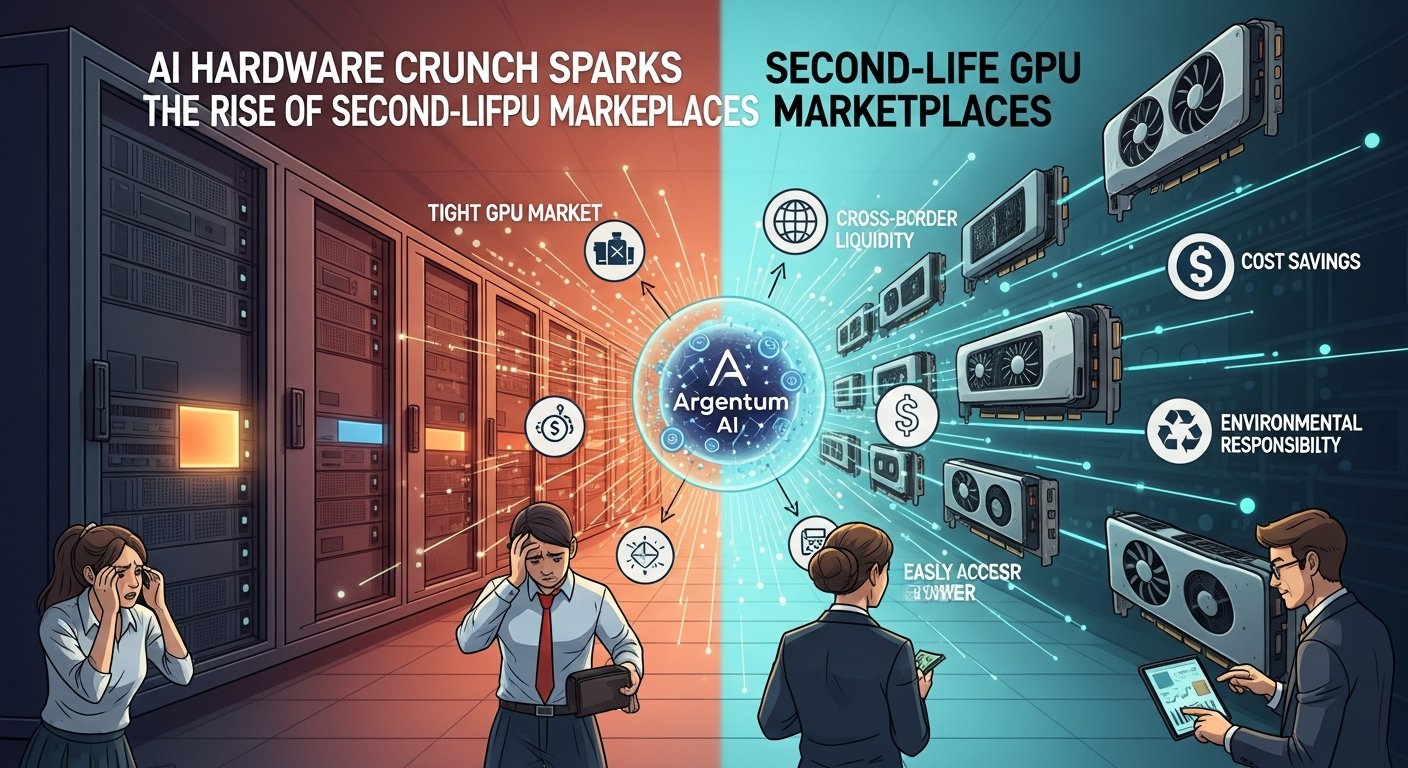
Because of the AI hardware crunch, companies are finding new ways to get computing power. One of these is the rise of “second-life” GPU marketplaces. Companies are using repurposed GPUs that were previously used to run modern AI workloads because there is a lot of new demand and not enough supply. This saves a lot of money and gives them more options for how to get compute.
A Tight GPU Market and Rising Demand
A tight GPU market is making big players lock in capacity long before they need it. Reports show that there is still a bottleneck because hyperscalers are buying up the best chips and saving them for future projects. Even though demand is still rising, supply can’t keep up because of manufacturing cycles and problems in the supply chain.
The Blackwell GPU lineup, which was once seen as the best option, sold out quickly in this environment. This shows how big the gap is between what businesses want and what the market can provide.
Analysts in the field say that AI computing has a huge, multi-trillion-dollar potential in the coming years. By the end of the decade, they expect hundreds of billions of dollars to be invested in it every year. But more and more people agree: there isn’t enough raw power to run cutting-edge AI workloads compared to the demand for it.
A Two-Tier AI Infrastructure System
This mismatch has created a two-tier system in AI infrastructure. Big companies with lots of money and aggressive buying strategies have gotten a lot of the available capacity, while smaller companies have a hard time finding reliable, cheap resources.
In this situation, second-life GPU marketplaces have become a strong option. These platforms offer a faster and cheaper way to get enterprise-level AI workloads by redistributing and repurposing GPUs that are already in use. They can save up to 70% compared to traditional cloud pricing.
It works like the logic of refurbished hardware markets, but with a focus on specialised AI computing and performance guarantees.
Argentum AI: A Decentralised Compute Marketplace
Argentum AI is a well-known example in this area. The project aims to be a safe, decentralised compute marketplace that is made for enterprise workloads.
Instead of using a single, centralised data centre, Argentum focusses on privacy-protecting features like secure enclaves and zero-knowledge proofs, along with staking-based trust mechanisms to make sure that data is accurate and can be verified.
In real life, this means that a workload can be sent to any available hardware on a distributed network, with cryptographic guarantees that the data stays private and the calculations can be checked.
Cross-Border Liquidity and Global Flexibility
The idea of cross-border liquidity is a unique feature of Argentum AI. Geographic limits often limit where compute resources can be found, but the platform says it can automatically send workloads to systems that are available anywhere on the network.
For businesses that work in more than one region, this could mean more consistent performance and faster time-to-value, all without being tied to a single cloud region or data centre.
Serving Enterprises and Individual Users
Argentum’s ecosystem isn’t just for big businesses; it also caters to hobbyists and smaller-scale computer users. The platform thinks about a wide range of users, from big organisations to individual fans, while still following rules, being open, and having performance metrics that can be verified.
This two-pronged approach aims to find a middle ground between the needs of enterprise-grade reliability and the flexibility and openness of wider participation. This could speed up AI testing and deployment at many levels.
Environmental Responsibility and Sustainability
Being responsible for the environment is a big part of this crowd-sourced computing model. The AI hardware cycle uses a lot of energy and is being looked at more closely for its effect on the environment.
If AI adoption speeds up without any improvements in efficiency, projections say that electronic waste related to AI could reach millions of tonnes every year by the end of the decade.
Supporters of second-life marketplaces say that reusing old GPUs can help lessen some of that impact by making hardware last longer and cutting down on the need for new resources.
But to make sure that real sustainability gains happen, responsible management is still very important. This includes safe data sanitisation, safe decommissioning, and clear reporting of where hardware came from.
Looking Ahead: The Future of Second-Life GPU Marketplaces
The market for second-hand GPUs looks like it will grow as the AI arms race heats up. The bottleneck that limits the supply of new hardware makes people want flexible, cost-effective options that can grow with demand.
Platforms like Argentum AI, which are decentralised and focused on security, are part of a larger trend in the industry to use existing GPU investments in new ways while still meeting governance and compliance standards.
These marketplaces could be a useful way to get from one generation of chips to the next, which will have new features like better performance-per-watt, memory bandwidth, and AI-specific accelerators.
Conclusion
In short, the second-life GPU marketplace is a practical response to the current imbalance between supply and demand for AI computing power. These marketplaces provide a feasible means for companies, ranging from startups to hyperscalers, to expedite AI initiatives by prolonging the operational lifespan of existing hardware, implementing secure and verifiable processing, and facilitating cross-border workload routing, thereby reducing the necessity for complete reliance on new hardware acquisition.
The focus seems to be shifting towards smarter use of what already exists as the industry waits for the next wave of AI accelerators. This approach could work well with traditional cloud and on-prem solutions while cutting costs and waste.