
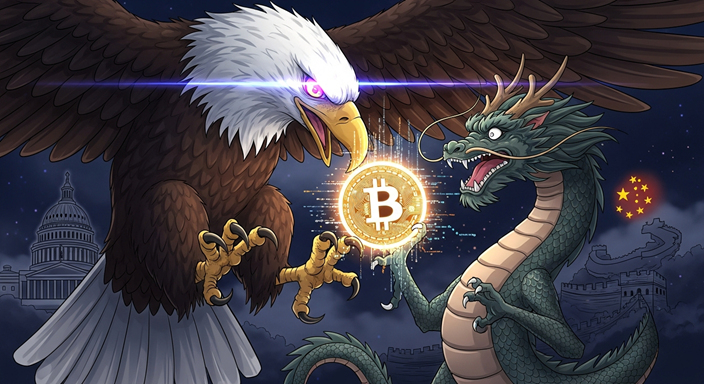
A shocking claim from China has put the country in the news: the US planned a huge Bitcoin theft.
The Chinese government says that almost $13 billion worth of Bitcoin was stolen from the LuBian mining pool in December 2020. They say it was a state-sponsored operation linked to the U.S. government. The claim has started a worldwide discussion about digital finance, cyber norms, cryptocurrency security, and geopolitical power.
Allegations of State-Sponsored Bitcoin Theft
China’s cybersecurity agency says this wasn’t a crime that happened by chance by people acting on their own. Instead, they say it was a carefully planned operation that was probably led by U.S. intelligence and backed by what they say is strong evidence.
They say that the way the money moved—quietly and slowly—points to government-level action instead of just regular crime. If this is true, it would mean that cyber warfare is getting worse and that people around the world should be worried about trusting digital currencies.
Global Impact on Cryptocurrency Confidence
The effects go beyond the problems between the U.S. and China. If state-sponsored cyber theft happens, it could change the way people think about cryptocurrencies and make people less confident in them.
To protect digital assets from threats backed by the government, the international community may feel pressure to strengthen security frameworks. This could change how cross-border crypto transactions and ownership are handled.
The U.S. Legal Response
The legal story has been the main focus of the US response. The Department of Justice (DOJ) says that the seizure of Bitcoin is part of a larger fraud investigation that includes Chen Zhi, a Cambodian businessman linked to a network accused of illegal activities.
Chen is being charged with a number of crimes, including money laundering and wire fraud conspiracy. Prosecutors say that the cryptocurrency that was taken came from scams linked to Chen’s businesses and his mining operations, such as LuBian.
Defense Perspective
Chen Zhi’s lawyer disagrees with the way the government is portraying him, saying that the claims are wrong. He says that the defense is working with cryptocurrency experts to find the Bitcoin that was legally taken more than a year ago, and he says that the government’s framing makes the transactions too simple.
Prosecutors say that Chen is not in U.S. custody, even though he has been charged.
U.S.–China Standoff
The lack of a response from the Chinese embassy in Washington has made Beijing’s comments seem more important. According to reports, U.S. officials deny China’s claims, saying that the seizure of Bitcoin was legal and related to the Chen case, not a separate action by the state.
This standoff shows how Bitcoin can be used as a geopolitical tool and adds to the arguments about digital sovereignty and cross-border crypto governance.
Historical Context of Cyber Accusations
China’s recent comments are part of a larger trend of accusing the U.S. of cyber activity.
-
Earlier this year, Beijing said that Washington used a flaw in Microsoft Exchange to attack Chinese companies.
-
Last month, it said it had proof that an attack had happened on China’s National Time Service Centre.
Some people say that China’s accusations don’t have the same level of forensic detail as U.S. accusations against other countries, which makes the story harder to follow.
Tracking the Bitcoin
Chen Zhi’s lawyers have asked for more time to find the Bitcoin, saying that public claims don’t accurately describe the situation.
Matthew L. Schwartz, Chen’s lawyer and a partner at Boies Schiller Flexner, says that cryptocurrency experts are involved in the tracing effort.
Arkham Intelligence, a company that analyses blockchain data, has been keeping an eye on LuBian-related activity during that time. Beijing has questioned the timing because a big transfer happened at the same time as the DOJ’s public case.
The Chinese cybersecurity authority says that the timing of the transfer doesn’t match a normal enforcement seizure. This suggests that the U.S. may have gotten to the money sooner than it said it did.
Broader Implications for Crypto Governance
The LuBian dispute has made the larger discussions about digital asset sovereignty even more heated. Experts say that crypto enforcement has become a tool for countries to show their power by seizing assets and using the law.
Bitcoin’s lack of sovereignty makes it harder to enforce laws across borders, and organisations like the Financial Stability Board have pointed out growing gaps in global crypto regulation. Countries could act alone and pursue strategic goals that could hurt public trust if there isn’t a common framework.
China and the Digital Yuan
As a way to fight back against Western dominance in crypto infrastructure and surveillance, China has pushed its own blockchain projects and digital yuan.
The U.S. has used strong enforcement to reach more people in crypto cases across borders, just like it did in the past with illegal markets and major exchanges. Critics say that a fragmented, politicised approach could damage trust between countries and make crypto seizures more like political tools than legal ones.
Conclusion
In short, the LuBian controversy shows how digital assets have become mixed up with politics around the world.
As countries work on making new rules, it will be important to have clear, consistent standards and work together across borders to keep the cryptocurrency world stable and trustworthy.